History of Immigration, Citizenship & Form I-9
The earliest federal law governing U.S. immigration and citizenship was the Naturalization Act of 1790, enacted by the First Congress and signed by President George Washington on March 26, 1790. This legislation established the country’s first uniform rule for naturalization, allowing free persons of good character who had resided in the United States for at least two years (and one year in their state of residence) to apply for citizenship through a court of record, after swearing an oath of allegiance to the Constitution. It also extended citizenship to the children (under 21) of naturalized citizens and to certain children born abroad to U.S. citizens, laying foundational procedures for how immigrants could become citizens while imposing significant restrictions on eligibility—a limitation that persisted in various forms until 1952.
Nearly two centuries later, the Immigration Reform and Control Act (IRCA) of 1986 marked a major shift by introducing employer sanctions to address unauthorized employment. Enacted on November 6, 1986, IRCA made it unlawful for employers to knowingly hire or continue employing individuals not authorized to work in the United States. To enforce this, the law required employers to verify the identity and employment eligibility of all new hires through the completion of Form I-9, Employment Eligibility Verification—a key tool designed to confirm that employees are U.S. citizens, nationals, lawful permanent residents, or otherwise work-authorized.
Form I-9 has been mandatory for every employee hired on or after November 6, 1986, serving as the primary mechanism for employers to document and reverify work eligibility. While the basic form is straightforward, the I-9 process can encompass multiple documents, including copies of identification (such as passports, driver’s licenses, or Social Security cards), additional pages for explanations (e.g., for name changes or reverifications), and supporting records. Employers must retain these completed forms for inspection by government agencies, with violations potentially leading to civil or criminal penalties under the Immigration and Nationality Act.
Form I-9 Versions
Form I-9, the Employment Eligibility Verification form, has undergone numerous revisions over the years, resulting in multiple versions that employers must carefully track for compliance. These versions vary in format, with some spanning multiple pages (including separate supplements for reverification and rehires) and others streamlined into a more concise structure. A significant redesign occurred in August 2023, when USCIS introduced a revised edition (dated 08/01/23) that consolidated Sections 1 and 2 into a single page for many users, shortened the instructions considerably, and improved overall clarity and usability to reduce errors.
The edition date appears at the bottom left of the form (and instructions), while the expiration date is printed at the top right. Employers are permitted—and often do—use versions past their printed expiration date until USCIS announces otherwise or issues a new mandatory version, as long as official notices or guidance allow it; however, it is critical to monitor USCIS announcements for any restrictions or required transitions. In August 2023, a one-page version with greatly improved, shortened instructions was published with a 07/31/2026 expiration date, but it was quickly updated to reflect an extended expiration of 05/31/2027 (still bearing the 08/01/23 edition date). Downloads from the USCIS site now provide only the 05/31/2027 version. Starting August 1, 2026, employers must use the Form I-9 version with the 05/31/2027 expiration date, and those using electronic systems must update accordingly by July 31, 2026, to reflect this extended validity.
Section 1
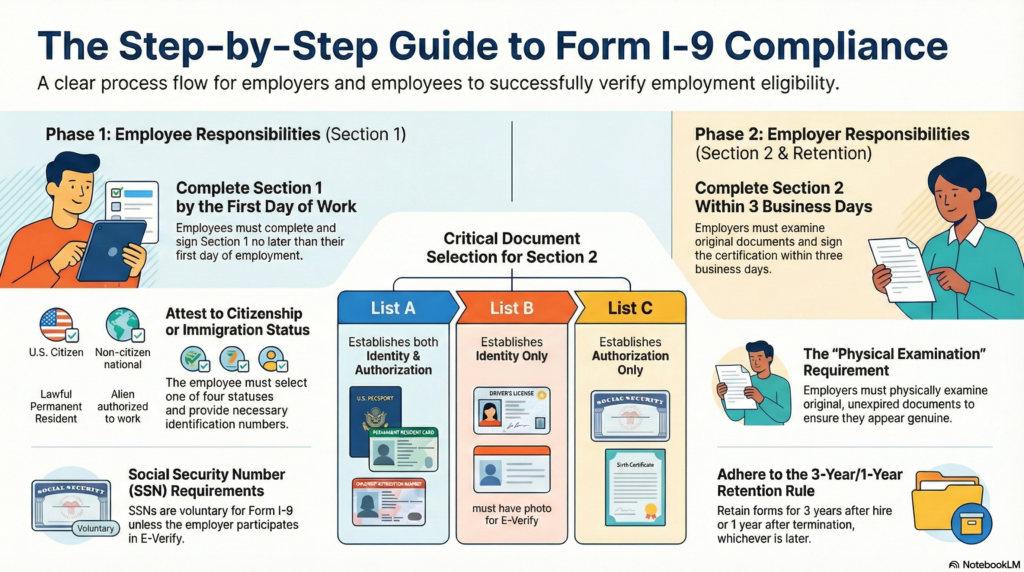
Section 1 of Form I-9, titled “Employee Information and Attestation,” is completed by the employee (not the employer) no later than their first day of employment. Its primary purpose is for the employee to provide personal details and attest under penalty of perjury to their identity and authorization to work in the United States, attesting to one of four citizenship or immigration statuses: U.S. citizen or noncitizen national, lawful permanent resident, or alien authorized to work (with corresponding identification numbers like USCIS/A-Number or Form I-94 number if applicable). Required fields include the employee’s full legal name (including any other last names used, such as maiden names), address, date of birth, citizenship/immigration status selection, and Social Security number (if the employer participates in E-Verify or it exists). Optional fields include email address and telephone number, which can facilitate E-Verify notifications but are not mandatory.
The employer is responsible for ensuring that Section 1 is completed correctly and fully, reviewing the provided information for accuracy and completeness (such as proper name entry, correct status box checked, and signature/date), though the employer may not request or require any documents to support or verify the information entered in Section 1—the employee swears to its accuracy via their attestation and signature. If the employee is unable to complete Section 1 on their own (e.g., due to language barriers or other reasons), a preparer or translator may assist, but the employee must still personally sign and date the section, and the assisting individual must complete, sign, and date the Preparer and/or Translator Certification (Supplement A) on a separate page. This structure helps prevent discrimination by prohibiting employers from demanding proof of citizenship, immigration status, or national origin during this phase, while placing the onus on the employee for truthful self-attestation.
Citizenship Status
Form I-9, the Employment Eligibility Verification form, requires employees to attest in Section 1 to one of four citizenship or immigration statuses, each reflecting a different level of connection to the United States and work authorization. These categories help employers verify eligibility without discriminating based on national origin or citizenship.
- A citizen of the United States — This includes individuals who are U.S. citizens by birth (e.g., born in the 50 states, District of Columbia, Puerto Rico, Guam, U.S. Virgin Islands, or Northern Mariana Islands) or through naturalization after meeting requirements like lawful permanent residence and passing a citizenship exam. U.S. citizens have full rights, including voting and unrestricted employment, and can present documents like a U.S. passport or birth certificate plus ID for Form I-9.
- A noncitizen national of the United States — This status applies primarily to people born in American Samoa or Swains Island (U.S. outlying possessions), who owe permanent allegiance to the U.S. but are not full citizens unless they naturalize. They can live and work freely in the mainland U.S. without restrictions, similar to citizens, and often use a U.S. passport (issued to noncitizen nationals) or other List A documents for verification. Noncitizen nationals are distinct from citizens in that they lack automatic voting rights in federal elections unless they reside in a state and naturalize.
- A lawful permanent resident — Also known as a green card holder or immigrant, this status is for individuals granted permanent residence in the U.S., placing them on a formal path to citizenship through naturalization after typically five years (or three if married to a U.S. citizen). They have broad work authorization and can live indefinitely but must maintain residency rules and can present a Permanent Resident Card (Form I-551) as a List A document.
- An alien authorized to work (sometimes still labeled “A noncitizen authorized to work” on certain form editions) — This covers non-immigrants (temporary visitors or workers) who are not citizens, nationals, or lawful permanent residents but have been granted specific work authorization, such as through visas (e.g., H-1B, F-1 with OPT, J-1), an Employment Authorization Document (EAD/Form I-766), or other temporary permissions. They are not on a permanent path to citizenship unless they later adjust status, and their work authorization often has an expiration date requiring reverification on Form I-9.
Section 2 and Certification
Section 2 of Form I-9, titled “Employer Review and Verification,” is completed by the employer (or an authorized representative) after the employee presents acceptable documentation. The employer must examine the original, unexpired documents in the employee’s physical presence (or via a DHS-authorized alternative procedure, if applicable) within three business days of the employee’s first day of paid employment. To satisfy the verification requirement, the employee may present one document from List A (which establishes both identity and employment authorization, such as a U.S. passport or Permanent Resident Card) or a combination of one document from List B (establishing identity, such as a driver’s license) and one from List C (establishing employment authorization, such as a Social Security card). The employer records the document title, issuing authority, number, and expiration date (if any) in the appropriate columns of Section 2, ensuring the documents reasonably appear genuine and relate to the employee, without specifying which documents the employee must choose.
The employer must fully describe the document by listing the Document Title, Issuing Authority, Document Number, and Expiration Date (if there is one). While common abbreviations are acceptable, employers should be careful not to be too brief. For example, many people may know that “DMV” is the abbreviation for “Department of Motor Vehicles” but if the employer doesn’t include the state in the Issuing Authority, the description of the driver license is deficient.
In the Certification portion of Section 2, the employer attests under penalty of perjury that they have examined the presented documents, that they appear genuine and relate to the employee, and that the employee is authorized to work in the United States. Critically, the person who views and examines the ID documents in the presence of the employee must be the same person who signs and dates the Certification—no one else can sign on their behalf. The signature and date must reflect the actual date the examination and completion occur, as backdating is strictly prohibited and can constitute fraud or lead to penalties during audits or inspections. Employers should use the real date of verification to maintain compliance and accuracy.
Pre-filling fields in Section 2 is strongly discouraged, as the section must be completed based on the actual documents presented and examined at the time of verification. Entering information prematurely (before seeing the originals) risks inaccuracies, non-compliance, or appearances of impropriety, and USCIS guidance emphasizes that the employer should only record details after physically reviewing the documents. All entries in Section 2, including the hire date (the employee’s first day of work), must be accurate and timely to avoid technical violations, with the completed and signed form retained for government inspection as required under the Immigration and Nationality Act. The same applies to the Certification, although pre-filling the company’s legal name and address is permitted.
I-9 Instructions & Languages
Employers are required to ensure that employees have access to the Instructions for Form I-9 (along with the Lists of Acceptable Documents) when completing the form, typically by providing a hard copy or a hyperlink to the official USCIS instructions before or at the time the employee fills out Section 1. This requirement helps employees understand how to accurately complete their portion of the form, including what information to provide, which documents they may present later, and their rights and responsibilities under the law. USCIS guidance emphasizes making these instructions available to newly hired employees to support proper completion and avoid errors.
Form I-9 and its instructions are available in both English and Spanish versions. Employers in the United States (including the 50 states and most territories) must complete and retain the English-language version of Form I-9 for official records. Only employers located in Puerto Rico may complete and use the Spanish-language version of Form I-9 in place of the English version. However, any employer anywhere may use the Spanish-language form and instructions as a translation tool to assist Spanish-speaking employees in understanding and completing the required English-language Form I-9.
Acceptable Documents
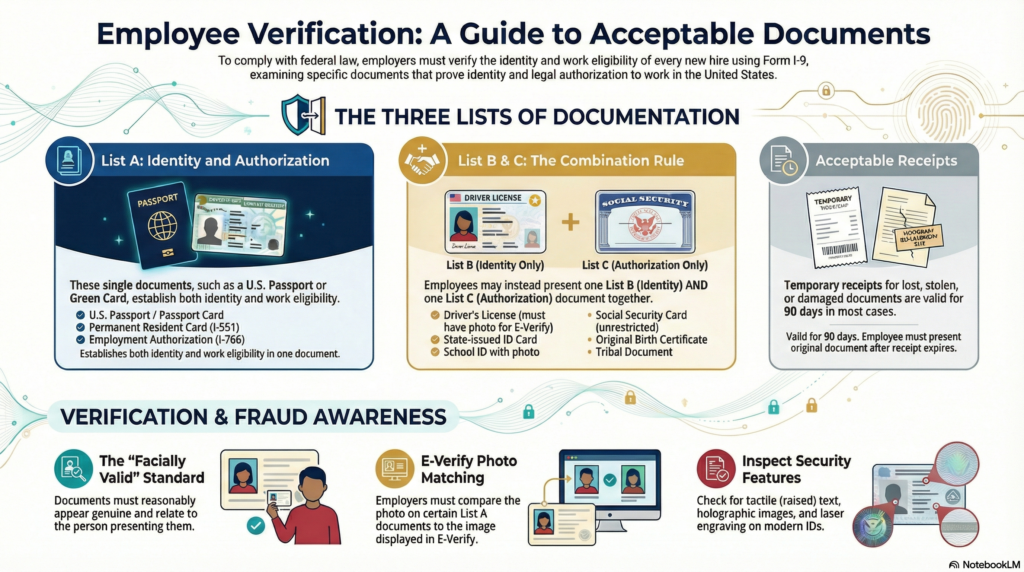
The Lists of Acceptable Documents on Form I-9 (typically printed on page 2 of the form or provided as a separate attachment) serve as the official USCIS-approved reference that outlines which documents employees may present to prove their identity and employment authorization in the United States. The purpose is to standardize the verification process under the Immigration Reform and Control Act (IRCA) of 1986, ensuring employers can confirm that new hires are legally eligible to work while preventing unauthorized employment. These lists categorize documents into three groups: List A (documents that establish both identity and employment authorization, such as a U.S. passport or Permanent Resident Card, allowing the employee to present just one item), List B (documents that establish identity only, such as a driver’s license or state ID card), and List C (documents that establish employment authorization only, such as a Social Security card without employment restrictions or a U.S. birth certificate). Employees have the freedom to choose any acceptable combination—one from List A, or one from List B combined with one from List C—without the employer specifying or demanding particular documents.
This structure promotes compliance, reduces the risk of discrimination (as employers cannot require proof of citizenship, immigration status, or national origin beyond what’s needed for verification), and helps employers meet their legal obligation to examine original, unexpired documents (or acceptable receipts in limited cases) in the employee’s presence. By providing the Lists to employees—either as a hard copy or via a direct hyperlink—employers ensure transparency and enable accurate completion of Section 2 of Form I-9, where the employer records the presented documents and certifies their review. All documents must reasonably appear genuine and relate to the person presenting them, and the lists are periodically updated by USCIS to reflect changes in acceptable forms of identification.
More about Acceptable Documents
- “One from List A, OR a combination of one from B and one from C”
- Certain List A documents (#3 and #5) can be a combination of two or three documents. The first document proves identity; the second and/or third document proves work eligibility. All documents are described separately in the List A column.
- List A #3 will only be presented by a lawful permanent resident (usually conditional) while #5 will be presented by a nonimmigrant who comes into the U.S. to work for a specific employer, for education, or as an exchange student.
- Both documents in the List A combo must be unexpired when presented.
- The expiration date of a school ID may have to be “calculated.” For a “year only” date, the expiration date is the last day of the school year. For a “month and year” date, the last day of the month.
- https://www.uscis.gov/i-9-central/form-i-9-acceptable-documents
Receipts
An employee may present a receipt when they do not have the actual document but have applied to replace it.
- The receipt must be for the replacement of a lost, stolen, or damaged acceptable List A, B, or C document. You may not accept a receipt for the first issuance of a document, nor for an EAD.
- The receipt must be issued by the government agency that will issue the actual document. Third-party or commercial receipts are not acceptable.
- An I-797C “Receipt Notice” is not an acceptable receipt under the receipt rule.
- The employee must present the actual document to you within 90 days. You must update Section 2 of the I-9 when presented.
- You may not accept a receipt for a driver license or non-driver ID renewal. However, be sure to distinguish between a receipt for renewal and a temporary, paper copy of the actual license which is acceptable the same as the actual license. The paper copy must bear all of the same information as the actual license including a photograph.
- https://www.uscis.gov/i-9-central/form-i-9-resources/handbook-for-employers-m-274/40-completing-section-2-employer-review-and-verification/44-acceptable-receipts
- https://www.uscis.gov/i-9-central/form-i-9-acceptable-documents/receipts
Resources
- “I-9 Central” — https://www.uscis.gov/i-9-central
- M-274 Handbook for Employers — https://www.uscis.gov/i-9-central/form-i-9-resources/handbook-for-employers-m-274
- E-Verify User Manual — https://www.e-verify.gov/e-verify-user-manual
Last Update: 2602050942